“I look through the thick and cold fog, and there are these static shadows, that has remained for the passage of time, alive even by a creek that is full of drops. They produce sounds that I manage to perceive. Smooth infinite sound, eternal as the grief of the forgotten but does not stop crying.
They were taken away
We love them.
It encloses me, and I choke, and I feel my eyes explode, and I only have one shadow left, that although it is black and thick, a circle of light lets me breathes.”
Paola Garcia Casanova




Project Proposal
CONCEPTS/IDEAS
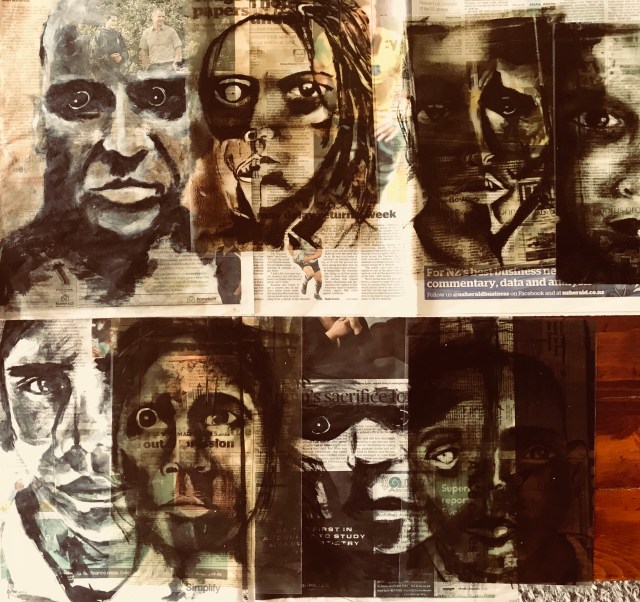
We can observe a compilation of black and white sketches, looking for simplicity and emphasis of each face. drawn in newspapers to connect the information and daily events in part of the life of each portrait. We can find different sizes, installed on a wall to invoke their individual history, like an altar. Raising questions about the absent and present and the brevity of the memory of each individual
In this series of portraits, they are focused on the disappearance of children, which occurs daily, across the world and which have been fatally found. Using photographs used by relatives to find them. Raising two points of view, one is what the photographer captures and the other is the reality and the destiny that these children had.
Each portrait has a different distortion according to the circumstances of each case, often grotesque and dark, to give a sense of greater anguish and at the same time show a vision of a more desperate world, evoked in the faces by tragic and ambiguous episodes, turning them into victims, not only of third parties but of oblivion. Each viewer is invited into a reflection on the fragility of Innocence and the capacity for cruelty and coldness of each human being as a cry for help through each sketch. An infinite silence of those who no longer have a voice. Be printed on those posters so fragile that time was defoliated and burned like autumn leaves. Faces manipulated by time, scratched and shattered like oblivion itself. It is the need for perpetuity, because somehow, we all want to stay. Death is a tragic destiny of man and, why not say it, that which erases his identity, his individuality from the face of the earth and the memory of those who remain alive.
The series of portraits has had a great influence, not only on personal experiences, but on great artists who, in one way or another, through different branches of the arts, have pursued a change, as does Joel Flores, a Mexican writer in one of his works, “Never again your name” (2017) is a novel to pay off debts, clear ghosts as an equation that should give the right result or something will be ruined forever, but also about how a writer is made and the decisions he must make consequently, he must survive in a country where it is not possible to eat what is written. It is also a story about what happens in newsrooms, when the fourth power stretches the mendicant hand to official advertising. It is, in a very painful way, a story about the violence that has not stopped beating our country and that has not ignored a single city or town of the national territory, filling them with the dead and disappeared. It provokes in me the need to find a way to produce images. a visual provocation a cry for help that we cannot ignore. Finding another way to express the same idea and produce the same result.
OBJECTIVES
This week I continued with the face modification in general
Very influenced by the cubist style that I had already experienced last year but this time only half of the face, each modification is influenced by the disappearances and many times found Dead in a horrible way, and after a long time. What makes me think about the shape of the photograph and the destiny of each one as different as seen in the photograph and looking for some way to portray the two faces of that photograph reminds me a lot of the masks that were used for funerals in rituals and ceremonies, which were often illustrative with stories and meaning as symbolic and I think it is the best way to reproduce the other half of their faces.
http://www.precolombino.cl/exposiciones/exposicion-permanente-america-precolombina-en-el-arte/mesoamerica/vitrina-mascaras-y-mascaretas/
PROCESS
I have produced a series of portraits that have evolved week after week, at first, they were just simple drawings with some alterations with a marked style like cubism. After that I was focusing on the alterations trying to follow the Picasso line, after some experimentations like the transparency of the newspaper to a high quality paper like the use of acetone after scanner of the newspaper and continuing the use of transparent sheets and modification of the tones, because it seemed not really deep the contrast due to the problem of the quality of the paper of the Newspaper. Many questions came to me because, as the transparency of the image did not seem honest to the intention of the Project itself, after a series of experiments it returned to my essence since I started to draw the use of other components such as It is brown to produce the sepia tone and the drawings are not drawn with pencil strokes but with my fingers and stains producing something more physical in the development of the sketches, finding more depth and more tonality over time.
RESEARCH
The ideas that have helped me face research and the validation of the use of photographs plus technical concepts and experimentation are the following:
BIOGRAPHY
AUMONT, J. El rostro en el cine. Barcelona:
Ediciones Paidós Ibérica, S.A., 1992.
BERGER, J. Otra manera de contar. Barcelona:
Gustavo Gili, 2013.
BERGER, J. Sobre el dibujo. Barcelona: Gustavo Gili, 2011.
CALVO, C. Carmen Calvo : [exposición] Institut Valencià d’Art Modern, 29 noviembre 2007 – 20 enero 2008 (Catálogo). Valencia: IVAM, 2007.
FRANCASTEL, Galienne y Pierre: El retrato. Madrid:
Cátedra, 1978.
GOMBRICH, E.H. Historia del Arte (16ª Edición).
Madrid : Phaidon, 2010.
GOMBRICH, E. H. “La máscara y la cara”, Arte, percepción y realidad. Barcelona: Paidós, 1973.
LATORRE IZQUIERDO, J. The Art of Photography: Towards an Aristocratic Vision. Communication & Society Navarra: 2000.
LUC-NANCY, J. La mirada del retrato. Buenos Aires:
Amorrortu, 2006.
MARTÍNEZ-ARTERO, R. El retrato: Del sujeto en el
retrato. Barcelona: Montesinos, 2004.
WILLIAM,A.E. El rostro humano: el nuevo retrato fotográfico. Barcelona:
Blume, 2008.
PÁGINE WEBSIDE
http://www.alertaambarmexico.org/search?updated-max=2015-10-05T16%3A48%3A00-07%3A00&max-results=7 (retrieved July 15, 2018).
DUMAS, Marlene. Web personal:
CHIAPPE, Paul. Web personal:
http://www.paulchiappe.com
DAYLY MAIL ONLINE, Small wonders: The tiny pencil portraits made to mimic Victorian-era photographs, Entrevista a Paul Chiappe
Paul-Chiappes-miniature-Victorian-
portraits-painstakingly- drawnPENCIL.html#ixzz4D9PqcHf4
(retrieved July 15, 2018).
DESTORTION
https://www.christies.com/zmags?ZmagsPublishID=21f639e7
https://www.christies.com/features/Pablo-Picasso-A-thirst-for-innovation-7739-1.aspx
_Simon de Pury Brings French Painter to NYC Art World
1-. https://news.artnet.com/market/simon-de-pury-brings-french-painter-to-nyc-art-world-92213
South African, b. 1955, Johannesburg, South Africa, based in Johannesburg, South Africa
http://www.artnet.com/artists/william-kentridge/drawing-for-lulu-a-b8sgy7AHNxS-fqlSsEDuCQ2
Biography
In his drawings and animations, William Kentridge articulates the concerns of post-Apartheid South Africa with unparalleled nuance and lyricism. In the inventive process by which he created his best-known works, Kentridge draws and erases with charcoal, recording his compositions at each state. He then displays a video projection of the looped images alongside their highly worked and re-worked source drawings. In this way, his process and aesthetic concerns are inextricably linked with the narrative power of his work, as in his “Nine Drawings for Projection” series (1989-2003), which depicts two fictional white South Africans navigating the ambiguities of contemporary South Africa. With his highly personal and often quiet works in seeming tension with the brutality of his content, Kentridge expresses a profound ambivalence about his native country.
Biography
Ellen Gallagher’s minimalist paintings, collages, and films examine the development of African-American stereotypes. The artist Incorporates pop culture ephemera into her work, particularly postwar-era advertisements for hairstyles, wigs, and skin products targeting African-American women. In her “DeLuxe” series (2004–05), Gallagher embellished images of hair-straightening and skin-whitening advertisements from magazines such as Ebony and Sepia. Viewed as intricate abstractions from afar, “DeLuxe” examines formal ideas about materials, seriality, and process alongside its narrative of race. Recurring elements in Gallagher’s work include minstrel-like lips, the use of penmanship paper and other found materials applied to canvas, and surfaces transformed to illegibility by methods like smudging, staining, and puncturing.
Related Categories
Identity Politics,Racial and Ethnic Identity,Contemporary Art,New York Artists,Women Artists,Engagement with Mass Media,20th Century Art,Appropriation,Grid,Traces, Indexes, and Implied Presence,Repetition,United States,Work on Paper,Contemporary Surrealistic,Collage,Film/Video,Contemporary Conceptualism,Erased and Obscured,Mixed-Media,Collective History,Human
https://creators.vice.com/es/article/53kb9z/distorsiona-la-realidad-y-el-rostro-humano-con-la-instalacion-digital-de-sehsucht
Vick Muinz – Brazilian:
• https://www.jpost.com/Arts-and-Culture/Arts/Material-man-350071
TECHNIQUES
I have also reviewed some works of Pablo Picasso and some form into distortion and use of newspapers.
I will continue working on the faces and play as many as possible. Different sizes and proportions.
http://www.brozalez.cl/brozalez/htm/trayectoria_II.htm
 PIOLINART